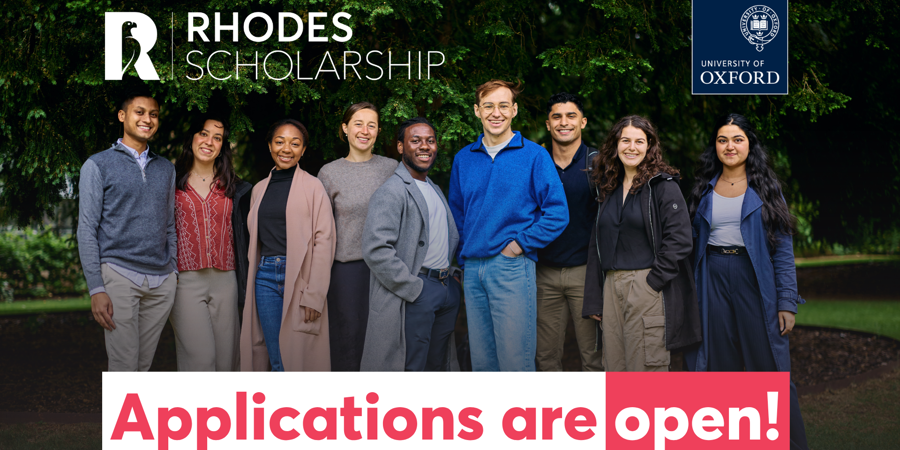
How to Apply for the Rhodes Scholarship 2027; The Rhodes Scholarship is one of the world’s most prestigious postgraduate scholarships.
It provides outstanding young people with the opportunity to undertake postgraduate study at the University of Oxford in the United Kingdom.
For applicants from Nigeria and other West African countries, the 2027 scholarship was administered through the Rhodes Scholarships for West Africa constituency. The 2027 scholarship is for students beginning at Oxford in October 2027.
Important 2027 update: For the West Africa constituency, applications opened on 1 June 2026 and closed at 23:59 GMT on 27 August 2026. The referee deadline was 3 September 2026. Since today is 10 September 2026, the 2027 West Africa application window has already closed.
If you are preparing for the next Rhodes Scholarship cycle, however, the requirements and strategy below are an excellent preparation guide. Dates for a future cycle should be confirmed when the Rhodes Trust publishes them.
1. What Is the Rhodes Scholarship?
The Rhodes Scholarship is a fully funded postgraduate scholarship that enables successful Scholars to study full-time at the University of Oxford.
The Rhodes Trust describes it as a programme designed to develop public-spirited leaders, encourage international understanding and build a global community of Scholars.
The scholarship is highly competitive. Academic excellence is important, but Rhodes selection is not simply a competition for applicants with the highest grades.
The selection process also looks closely at leadership, service, character, intellectual ability and the potential to make a meaningful contribution to society.
READ THIS: Nordic Open Positions 2027: Complete Guide to Jobs in Denmark, Finland, Iceland, Norway and Sweden
What does the scholarship cover?
How to Apply for the Rhodes Scholarship 2027; The Rhodes Scholarship is a fully funded award. Successful Scholars receive financial support associated with studying at Oxford, subject to the applicable conditions of tenure and the particular scholarship arrangement.
Because exact benefits and conditions can vary, applicants should always consult the current Rhodes Trust Conditions of Tenure before applying.
2. Who Can Apply for the Rhodes Scholarship from Nigeria?
Nigeria is part of the West Africa Rhodes Scholarship constituency.
The West Africa constituency covers:
- Benin
- Burkina Faso
- Cabo Verde
- The Gambia
- Ghana
- Guinea
- Guinea-Bissau
- Côte d’Ivoire
- Liberia
- Mali
- Mauritania
- Niger
- Nigeria
- Saint Helena
- Ascension and Tristan da Cunha
- Senegal
- Sierra Leone
- São Tomé and Príncipe
- Togo
There are three Rhodes Scholarships available each year for West Africa.
This makes the scholarship extremely competitive.
3. Rhodes Scholarship 2027 Eligibility Requirements
For the 2027 West Africa competition, candidates had to satisfy several requirements covering nationality, residence/education, age, academic achievement and English-language ability.
A. Nationality or citizenship
You must be a citizen of an eligible West African country.
For Nigerian applicants, Nigerian citizenship is one of the qualifying nationalities.
However, nationality alone does not necessarily make you eligible. The Rhodes Trust also applies education/residency criteria.
B. Education or residency requirement
For the West Africa constituency, applicants needed to have been resident in one or more of the eligible West African countries for at least five of the last ten years, subject to the precise rules in the official candidate guidance.
If you have lived, studied or worked in several countries, do not automatically assume that you should apply through West Africa.
The Rhodes Trust recommends using its eligibility checker to determine the appropriate constituency.
4. Rhodes Scholarship Age Requirement
Age requirements are particularly important because the scholarship is intended primarily for young postgraduate applicants.
For the 2027 West Africa competition, the standard age requirement was:
- 18–24 years old on 1 October 2026, meaning applicants generally had to have been born after 1 October 2001 and before 2 October 2008.
There were exceptions for certain professional students and older candidates who completed their first undergraduate degree later than usual.
For certain candidates studying:
- Medicine
- Dentistry
- Pharmacy
- Law
- Engineering
the applicable age rules can differ to accommodate professional internships.
How to Apply for the Rhodes Scholarship 2027; There is also a provision for some older applicants who completed their first undergraduate degree later than usual.
For the 2027 West Africa competition, such applicants generally had to be under 27 on 1 October 2026 and have completed their first undergraduate degree on or after 1 October 2025.
Why you should check your age carefully
Do not rely on statements such as “Rhodes is for people under 25.”
The exact age calculation depends on the constituency and the year in which you are applying.
Always check the official eligibility checker for the relevant application cycle.
5. Academic Requirements
Academic excellence is one of the most important parts of the Rhodes application.
For West Africa, the 2027 guidance required applicants to have completed an undergraduate degree, normally a Bachelor’s degree, by the application deadline with an academic record equivalent to a First Class Honours degree, while also meeting or exceeding the specific entry requirements of the Oxford course they intend to study.
This means that simply having a university degree is not enough.
You should be able to demonstrate:
- Excellent academic performance.
- Strong intellectual ability.
- Evidence that you can succeed at Oxford.
- Appropriate preparation for your proposed Oxford programme.
What if your university does not use a First Class system?
The Rhodes Trust recognises that universities use different grading systems.
The key issue is whether your academic record is considered equivalent to the required standard.
For medicine, dentistry and pharmacy, special provisions apply because universities may use different classifications. The West Africa guidance, for example, refers to the highest classification awarded by the university and additional distinctions in relevant subject areas.
6. English Language Requirement
You must have a sufficiently high level of English to satisfy the University of Oxford’s English-language requirements.
If you qualify for an Oxford English-language test waiver, you may be able to request a waiver rather than taking a test.
Do not assume that because you studied at an English-speaking university you automatically satisfy every Oxford language requirement. Check the current Oxford requirements for your intended course.
7. What Does the Rhodes Trust Look For?
One of the biggest mistakes applicants make is treating the Rhodes Scholarship as an ordinary academic scholarship.
It isn’t.
The Rhodes Trust is looking for people with the potential to become leaders and contributors to society.
The strongest application should therefore answer questions such as:
- What have you achieved?
- What problems have you tried to solve?
- Who have you helped?
- What did you learn?
- What motivates you?
- What intellectual questions interest you?
- What do you want to accomplish?
- Why does Oxford matter to your plans?
- How will your experiences shape your future contribution?
Academic excellence
You should demonstrate genuine intellectual curiosity rather than simply saying that you are “passionate about education.”
Examples might include:
- exceptional academic performance;
- research;
- publications;
- academic competitions;
- independent projects;
- intellectual societies;
- significant research experience;
- innovative academic work.
8. Leadership
Leadership does not necessarily mean being the president of a university association.
You can demonstrate leadership by showing that you:
- identified a problem;
- organised people;
- created a solution;
- built an initiative;
- persuaded others;
- improved an organisation;
- started a community project;
- created a business or social enterprise;
- led a research project;
- influenced policy or institutional practice.
A useful way to present leadership
Instead of writing:
“I am a great leader.”
Show:
Problem → Action → Leadership → Result → Lesson
For example:
You noticed that students in your community lacked access to educational resources, organised volunteers, created a tutoring programme, reached 200 students and subsequently developed a sustainable volunteer structure.
That is considerably stronger evidence of leadership than simply listing “leadership” as a skill.
9. Community Service and Impact
The Rhodes Scholarship also places importance on service and contribution.
Your service does not have to be international.
It could involve:
- education;
- healthcare;
- youth development;
- environmental work;
- technology;
- entrepreneurship;
- disability inclusion;
- women’s empowerment;
- community development;
- public policy;
- poverty reduction;
- agriculture;
- scientific research.
The important question is:
What difference did you actually make?
Where possible, quantify your impact.
Instead of:
“I volunteered to help students.”
Consider:
“I coordinated 18 volunteers who provided weekly tutoring to 120 secondary-school students over eight months.”
The second statement gives the selection committee something concrete to evaluate.
10. Character
Character is another important dimension.
The committee wants to understand how you respond when things become difficult.
Your application can demonstrate:
- resilience;
- integrity;
- courage;
- responsibility;
- empathy;
- humility;
- perseverance;
- willingness to learn from failure.
Do not try to make yourself appear perfect.
A convincing personal statement can acknowledge difficulties while showing what you learned and how the experience changed your approach.
11. Intellectual Independence
Rhodes applicants should be able to think independently.
You should be able to discuss:
- ideas you disagree with;
- questions you are still trying to answer;
- problems in your field;
- assumptions you have challenged;
- research that changed your thinking;
- experiences that caused you to reconsider your position.
This is particularly important because Oxford is academically demanding.
12. Choosing Your Oxford Course
Another important part of the application is deciding what you want to study at Oxford.
You should research your intended course carefully.
Consider:
- course structure;
- admission requirements;
- academic prerequisites;
- faculty members;
- research opportunities;
- duration;
- assessment methods;
- career relevance;
- how the programme fits your long-term objectives.
Do not choose a course simply because it sounds prestigious.
Your application should make a logical connection between:
Past → Present → Oxford → Future
For example:
How to Apply for the Rhodes Scholarship 2027; Undergraduate study → research/community experience → Oxford programme → long-term contribution.
The connection should feel natural rather than manufactured.
13. Do You Apply to Oxford or Rhodes First?
This is extremely important.
For the Rhodes Scholarship, you apply for the Rhodes Scholarship first.
You do not simply submit an Oxford postgraduate application and expect to be considered automatically for Rhodes.
According to the Rhodes Trust, successful Rhodes candidates then apply to their chosen Oxford programme following selection.
Winning the Rhodes Scholarship also does not automatically mean that you have been admitted to Oxford.
The scholarship selection and Oxford admission processes are separate.
Therefore, a successful Rhodes candidate must still satisfy Oxford’s admission requirements.
14. Documents You Should Prepare
Although requirements can change between application cycles, you should expect to prepare a package containing information such as:
1. Curriculum vitae
Your CV should clearly show:
- education;
- academic achievements;
- employment;
- leadership;
- volunteering;
- awards;
- research;
- publications;
- extracurricular activities;
- significant projects.
Keep it factual and evidence-based.
2. Academic records
Prepare your university transcripts and relevant academic documentation.
3. Personal statement
This is one of the most important components of the application.
It should explain who you are, what you have done, what you care about and what you intend to accomplish.
4. Academic statement
You may also need to explain your academic interests, proposed field of study and intellectual objectives.
5. References
You will need referees who can provide meaningful evidence about your abilities and character.
6. Proof of eligibility
Depending on your constituency and circumstances, you may need information supporting nationality, education, residency or other eligibility requirements.
How to Apply for the Rhodes Scholarship 2027; Always use the official candidate guidance for your particular constituency because requirements can change.
15. How Many Referees Do You Need?
Do not choose referees merely because they have impressive titles.
A professor who knows your work well is generally more useful than a famous person who barely knows you.
Your referees should be able to provide specific evidence about:
- academic ability;
- character;
- leadership;
- service;
- achievements;
- potential.
Good referees might include
- university lecturers;
- professors;
- research supervisors;
- employers;
- community leaders;
- professional supervisors.
The best referee is someone who can write specific examples, rather than generic praise.
16. How to Write a Strong Rhodes Personal Statement
Your personal statement should not read like a generic scholarship essay.
Avoid simply saying:
“I have always dreamed of changing the world.”
Instead, tell the committee what shaped you and what you have done about it.
A useful structure
Paragraph 1 — Your central story
Introduce an experience, problem or idea that has shaped your intellectual and personal journey.
Paragraph 2 — Your academic development
Explain how your education developed your interests.
Paragraph 3 — Your leadership
Discuss a significant example where you took responsibility and produced results.
Paragraph 4 — Your service
Show how you have contributed to other people or society.
Paragraph 5 — Your intellectual interests
Explain the questions you are interested in exploring.
Paragraph 6 — Your future
Explain what you want to accomplish and why Oxford is important to that goal.
Most importantly
Your statement should sound like you.
The Rhodes Trust specifically emphasises the importance of truthful and original personal and academic statements.
Do not pay someone to manufacture an impressive life story for you.
17. How to Make Your CV Competitive
Your CV should make it easy for the selection committee to understand your trajectory.
A useful structure is:
Education
- University
- Degree
- Dates
- Major academic achievements
Research
- Projects
- Publications
- Research assistantships
- Presentations
Leadership
- Position
- Organisation
- Dates
- Major achievements
Community service
- Organisation
- Role
- Impact
Awards
- Scholarship
- Competition
- Fellowship
- Academic award
Professional experience
- Employer
- Position
- Responsibilities
- Achievements
Avoid filling your CV with insignificant activities simply to make it longer.
18. How to Choose the Right Referees
Start contacting referees weeks or months before the application deadline.
Send them:
- your CV;
- your academic transcript;
- your draft personal statement if appropriate;
- your Oxford course information;
- a summary of your major achievements;
- the application deadline;
- information about why you are applying.
Then explain what you would like them to emphasise.
However, don’t write a reference for them to sign. They need to provide an independent assessment.
19. Step-by-Step: How to Apply for Rhodes Scholarship
The general process is as follows.
Step 1: Determine your Rhodes constituency
Go to the official Rhodes Trust application website and use the eligibility checker.
The Trust uses geographical constituencies to administer the scholarships.
For a Nigerian applicant, this normally means the West Africa constituency.
Step 2: Read the constituency-specific information
Do not rely only on general Rhodes Scholarship articles.
Read the official Information for Candidates for your constituency.
This is especially important because eligibility requirements, deadlines and selection procedures can differ between constituencies.
Step 3: Confirm your eligibility
Check:
- nationality;
- residence/education requirements;
- age;
- academic achievement;
- English-language requirement;
- Oxford course eligibility.
Do this before spending substantial time on your application.
Step 4: Research Oxford courses
Identify one or more appropriate Oxford programmes.
Make sure you satisfy the academic requirements.
Research the programme thoroughly.
Step 5: Build your CV
Document your:
- academic achievements;
- leadership;
- service;
- research;
- employment;
- awards;
- extracurricular achievements.
Step 6: Select your referees
Choose people who know your work sufficiently well to provide detailed references.
Contact them early.
Step 7: Write your personal and academic statements
Start early.
Don’t attempt to write the final version in one sitting.
A better approach is:
Brainstorm → draft → revise → receive feedback → revise → proofread → finalise.
Step 8: Complete the online Rhodes application
Applications are submitted through the Rhodes Trust’s online application system.
For the 2027 West Africa competition, applications opened on 1 June 2026 and closed on 27 August 2026.
Step 9: Submit before the deadline
Do not wait until the final hours.
Internet problems, missing documents, incomplete references or technical issues can create unnecessary problems.
Step 10: Make sure your referees submit their references
Submitting your own application is not necessarily the end of the process.
References have their own deadline.
For West Africa’s 2027 competition, the reference deadline was 3 September 2026, after the main application deadline.
20. What Happens After You Apply?
The West Africa selection process involves several stages.
For the 2027 competition, applications were checked for eligibility and completeness, followed by the creation of a longlist.
The West Africa process then included preliminary interviews and a final interview stage.
The 2027 candidate guidance stated that final interviews would be held in Abuja, Accra or Lagos in November 2026, with travel expenses within West Africa and accommodation provided.
Candidates selected as Rhodes Scholar-Elects are then expected to proceed with the Oxford admissions process.
21. Preparing for the Rhodes Interview
Do not wait until you are shortlisted before thinking about the interview.
Start preparing by understanding your own application extremely well.
Expect questions about:
Your background
- Why did you choose your field?
- What experiences shaped you?
- What have you learned from difficult experiences?
Your leadership
- What is the most important initiative you have led?
- What went wrong?
- How did you respond?
Your service
- Why does this problem matter?
- What did you actually accomplish?
- What would you do differently?
Your intellectual interests
- What are you reading?
- What academic problem interests you?
- What is your opinion on a controversial issue in your field?
Your future
- Why Oxford?
- Why this course?
- What do you want to accomplish?
- Why should society care about your proposed work?
22. Do Not Memorise Interview Answers
This is a common mistake.
How to Apply for the Rhodes Scholarship 2027; If you memorise scripted answers, you may struggle when the committee asks an unexpected follow-up question.
Instead, understand your own story.
Know:
- your major achievements;
- your failures;
- your motivations;
- your academic interests;
- your leadership experiences;
- your weaknesses;
- your future plans.
The goal is to have a thoughtful conversation rather than deliver a speech.
23. What Makes a Rhodes Application Weak?
Avoid these mistakes.
Mistake 1: Focusing only on grades
Excellent grades are important, but Rhodes is not simply an academic prize.
Mistake 2: Listing positions without achievements
Being “President” of an organisation is not automatically impressive.
Explain what you accomplished.
Mistake 3: Exaggerating
Do not inflate the number of people you helped or claim responsibility for things you did not do.
Mistake 4: Using generic leadership language
Statements like “I am passionate about leadership” mean little without evidence.
Mistake 5: Choosing Oxford merely for prestige
Explain why the particular programme is academically important to you.
Mistake 6: Starting too late
The application requires reflection, documentation, references and careful writing.
Start months ahead.
Mistake 7: Writing what you think Rhodes wants to hear
This can make your application sound artificial.
The Trust’s own materials emphasise authenticity and getting to know the individual applicant.
24. A Strong Preparation Timeline
If you are targeting the next Rhodes Scholarship cycle, a useful preparation schedule would look like this:
9–12 months before applications
- Research Rhodes.
- Confirm your likely constituency.
- Check age eligibility.
- Research Oxford courses.
- Review your academic record.
- Identify gaps in your profile.
6–9 months before
- Build your CV.
- Strengthen meaningful leadership/service activities.
- Begin developing your personal narrative.
- Identify potential referees.
3–6 months before
- Draft your personal statement.
- Draft your academic statement.
- Obtain feedback.
- Gather transcripts and supporting documents.
- Continue Oxford course research.
1–3 months before
- Finalise your essays.
- Confirm referees.
- Proofread your application.
- Check every eligibility requirement.
- Prepare for potential interviews.
Application period
- Complete the online application carefully.
- Upload all required documents.
- Submit before the deadline.
- Confirm that your referees have received their requests.
25. What Nigerian Applicants Should Pay Particular Attention To
For Nigerians, the West Africa constituency is especially important.
The competition is regional rather than simply a competition among Nigerian applicants. There are three Rhodes Scholarships available annually for West Africa, covering multiple countries.
Therefore, a strong Nigerian applicant should avoid building an application that is merely impressive by local standards.
Ask yourself:
If my application is compared with exceptional candidates from across West Africa, what makes my contribution distinctive?
Your answer could involve:
- groundbreaking research;
- entrepreneurship;
- public policy;
- technology;
- healthcare;
- education;
- environmental sustainability;
- agriculture;
- community development;
- human rights;
- scientific innovation;
- creative industries.
The key is evidence of achievement and potential, not simply the subject area.
26. Is the Rhodes Scholarship Fully Funded?
Yes. The Rhodes Scholarship is a fully funded postgraduate scholarship.
It is intended to support successful Scholars while they undertake eligible postgraduate study at Oxford.
However, applicants should read the current Conditions of Tenure carefully because funding arrangements and covered costs are governed by the official terms.
27. Can You Apply Without Already Being Accepted by Oxford?
Yes.
You apply to the Rhodes Scholarship first.
The Rhodes Trust explicitly states that scholarship applications submitted in 2026 were for Oxford entry in October 2027, and that successful scholarship candidates subsequently apply to their chosen Oxford programme.
But remember:
Rhodes selection ≠ automatic Oxford admission.
How to Apply for the Rhodes Scholarship 2027; You must still complete the Oxford admissions process and meet the university’s requirements.
28. What If You Missed the 2027 Application Deadline?
If you are a Nigerian or another West African applicant reading this now, this is particularly important.
The 2027 West Africa application deadline was 27 August 2026, so you cannot submit a new 2027 West Africa application after that deadline.
You should instead prepare for the next cycle.
Do not wait for the next application window to begin before preparing.
Use the intervening months to:
- Improve your academic profile.
- Build meaningful leadership experience.
- Undertake substantial community service.
- Develop a strong intellectual profile.
- Research Oxford courses.
- Build relationships with potential referees.
- Prepare your CV.
- Develop your personal story.
- Read widely in your intended field.
- Monitor the official Rhodes Trust website for the next application dates.
29. Official Rhodes Scholarship Application Resources
For future applications, start with the official Rhodes Trust rather than third-party scholarship websites.
Rhodes Scholarship overview:
Official Rhodes Scholarship information
Rhodes application and eligibility checker:
Rhodes Trust — Check Eligibility and Apply
West Africa Rhodes Scholarship:
Rhodes Scholarships for West Africa
West Africa 2027 candidate guide:
2027 West Africa Information for Candidates
30. Final Advice: How to Become a Strong Rhodes Candidate
The most effective approach is not to spend six months trying to “look like a Rhodes Scholar.”
Instead, build a meaningful record of academic excellence, leadership, service and intellectual curiosity, and then tell that story honestly.
A strong candidate can demonstrate:
Academic excellence
→ You are capable of succeeding at Oxford.
Leadership
→ You can take initiative and bring people together.
Service
→ You care about problems beyond yourself.
Character
→ You act with integrity and resilience.
Intellectual curiosity
→ You think deeply and independently.
Future potential
→ Your Oxford education will enable you to make an even greater contribution.
How to Apply for the Rhodes Scholarship 2027; For a Nigerian applicant, the most important immediate point is that the 2027 West Africa application window has already closed, but this is actually a good time to prepare for the next cycle. The official Rhodes Trust should be treated as the final authority because constituency rules and dates can change from year to year.